
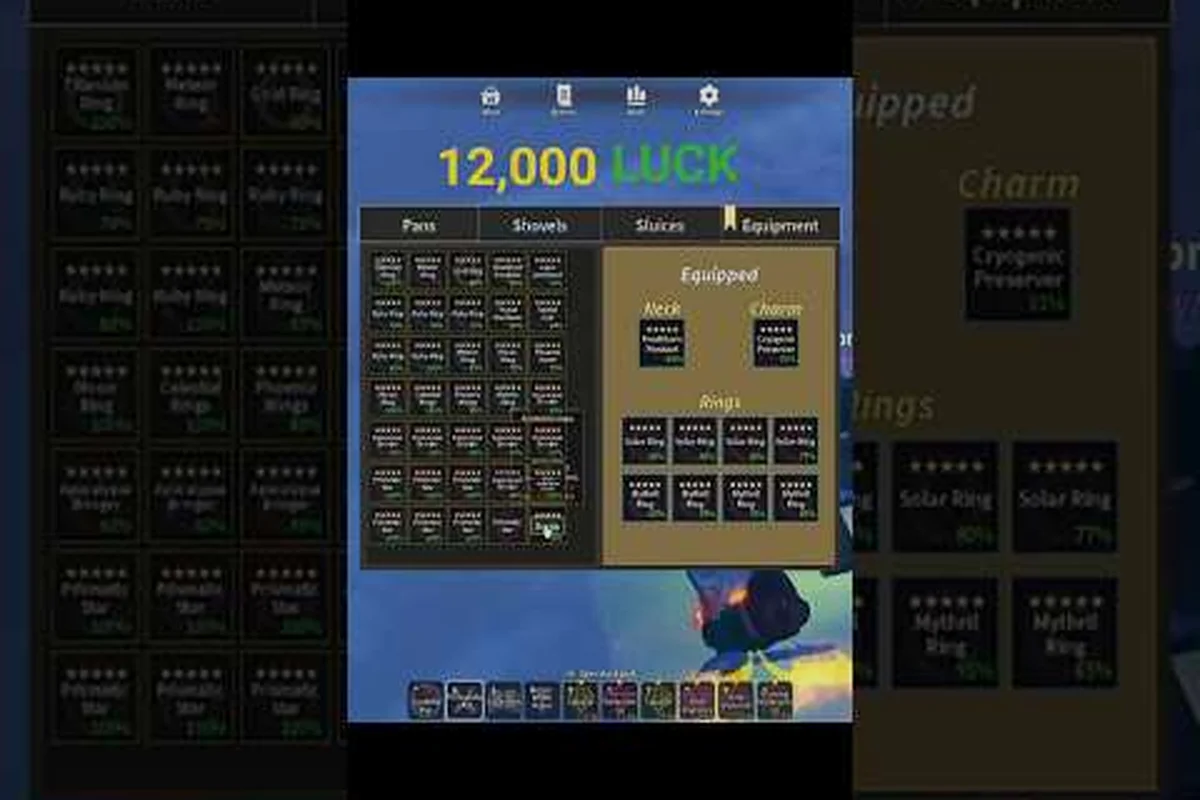
Discover rare ore modifiers using this Prospecting mutations guide, explaining how giant, shiny, and elemental mineral variants spawn and boost sell values.
How Prospecting Mutations Work and Why the Forge Matters
Prospecting mutations are the single biggest power spike most equipment can receive, and understanding the forge system is what separates casual panners from players who can actually push deep into high-tier biomes. According to the Prospecting official Roblox page, the game revolves around digging sediment, panning for valuables, and selling what you find — but the late-game loop is dominated by rolling modifiers onto your gear. Every pan, pickaxe, bottle, and rod can carry a mutation that boosts stats, alters behavior, or adds entirely new effects, and the mutation forge is the only reliable place to chase them.
The mutation forge sits in a dedicated area of the hub and accepts any eligible tool, which it then re-rolls with a random mutation drawn from that item's available pool. Players fuel the forge with in-game currency plus rare catalyst items, and the result is either a mutation tier upgrade, a brand-new effect, or a duplicate that overwrites a weaker modifier. Because the outcomes are weighted, the actual prospecting mutation chances for top-tier rolls like Prismatic and Overclocked are dramatically lower than the common tiers, which is why planning around the forge — rather than spamming rolls blindly — pays off over the long haul.
If you are still learning the basics of digging, panning, and selling, the Beginner Guide covers the early progression loop that you need to complete before the forge becomes worth your time. This article assumes you already know how to pan, enchant, and sell, and instead focuses on the mutation layer that sits on top of all of that.
Mutation Tiers and What Each Roll Actually Does
Mutations are organized into tiers, and each tier changes how valuable a roll is for both PvE performance and resale value. The table below summarizes the five main tiers that community data and the Prospecting community wiki reference most often, ranked from most common to rarest.
| Tier | Approx. Roll Weight | Typical Effect | Resale Behavior |
|---|---|---|---|
| Common | ~50% | Small stat boost | Sells for base value |
| Uncommon | ~25% | Moderate stat boost | Mild resale premium |
| Rare | ~15% | Strong stat boost + minor utility | Solid resale premium |
| Overclocked | ~7% | Doubles a key stat or adds a powerful proc | High resale value |
| Prismatic | ~3% | Multi-stat buff + cosmetic shimmer | Top-tier resale |
The exact percentages shift slightly as the developer rebalances the forge, and community testing on the latest patch reports the Prismatic weight closer to 1-in-33 rolls when a catalyst is used, but the relative ordering stays consistent. Overclocked and Prismatic together account for roughly one in every ten forge attempts, which means a focused session of ten rolls will statistically produce at least one of them — assuming you are using catalysts that raise the effective tier weight.
Why Mutation Rolls Matter More Than Raw Stats
A fully maxed pan without mutations will still underperform a mid-tier pan with a Prismatic roll in most late-game biomes, because mutation effects are multiplicative rather than additive. A Prismatic modifier on a pickaxe, for example, can boost both digging speed and rare-find chance at the same time, which is the kind of stacking that raw upgrades alone cannot replicate. This is why the forge is treated as a progression gate: once your equipment is fully upgraded, mutation quality is the only meaningful lever left to pull.
Prospecting Mutation Forge: Fuel, Catalysts, and Roll Strategy
The prospecting mutation forge is not a free re-roll machine; it costs resources, and understanding the fuel economy is what makes the difference between profitable forging and burning your bankroll. Every forge attempt consumes a base amount of gold that scales with the item's tier, plus a chance to consume an additional catalyst if you want to elevate the roll weights toward rarer tiers.
Core Forge Inputs
The inputs in the table below are what the mutation forge actually reads when calculating your prospecting mutation chances, and each one shifts the weight of either the Prismatic or Overclocked tier — not your raw roll odds. Gold alone can pay for a roll, but it contributes nothing to mutation chances beyond unlocking the attempt itself, which is why players chasing the Prismatic mutation almost always pair gold with a Prismatic Shard or a Lucky Charm to tilt the outcome.
| Input | Effect on Roll | Cost Tier |
|---|---|---|
| Gold (base) | Pays for the roll itself | Scales with item rarity |
| Prismatic Shard | Raises Prismatic tier weight by ~2x | Rare drop, high resale value |
| Overclocked Core | Raises Overclocked tier weight by ~1.5x | Mid-rare drop |
| Forge Ticket (event) | Free roll, standard weights | Limited-time only |
| Lucky Charm consumable | Flat +1% to top two tiers for 10 rolls | Purchasable in shop |
Players who can reliably farm shards and cores treat the forge as a long-term investment, while players who cannot usually save their gold for upgrading tools first and only forge once per major patch. According to community reports, the most efficient pattern is to stockpile catalysts during off-peak biomes, then burn them in a single session when a new patch drops — because new patches occasionally raise all mutation weights as a soft reset.
Step-by-Step Roll Session
A disciplined forge session in Prospecting is a short, planned window — usually 10 to 15 rolls — where you line up your catalysts, consumables, and target tools before opening the UI, instead of improvising one roll at a time. The core idea is to control every variable that influences prospecting mutation chances in a single block: the catalyst tier you're burning, the Lucky Charm buff duration still active, the patch's current weight table, and the resale floor of the tool you're about to gamble. Treat it like a craft batch rather than a single craft, because the forge has no pity timer and the Prismatic and Overclocked odds are thin enough that uncoordinated rolling burns gold fast. The five steps below are the concrete sequence players use to keep that batch efficient.
-
Step 1: Stockpile at least 10x your target catalyst before opening the forge UI, so you can sustain a full session without bouncing in and out of menus.
-
Step 2: Apply any active Lucky Charm consumable first, because the +1% buff stacks with your catalyst bonuses and is wasted on a single roll.
-
Step 3: Roll the lowest-value eligible tool ten times to test the current patch weights, then commit your best gear only after you confirm the rates feel right.
-
Step 4: Stop after you hit at least one Prismatic or two Overclocked rolls, because chasing beyond that point historically bleeds gold without improving your average outcome.
-
Step 5: Sell or trade the rolled tool only if the mutation is below Rare tier, because Common and Uncommon rolls have poor resale value and are usually worth re-rolling again later.
The reason this five-step pattern matters is that the forge has no pity timer, so chasing a Prismatic with no plan is the fastest way to drain a session's worth of gold. Players who front-load their catalyst stockpile and apply Lucky Charms first consistently report better prospecting mutation chances per session than players who roll one tool at a time as resources trickle in.
Prospecting How to Get Mutations: Drop Sources, Events, and Quests
Prospecting how to get mutations breaks down into three reliable paths: farming catalysts from biomes, completing limited-time events, and rolling at the forge. Each path produces a different type of mutation-related reward, and knowing which path to prioritize is what makes your weekly session feel productive rather than scattered.
Source Comparison
| Source | What You Get | Best For | Time Cost |
|---|---|---|---|
| High-tier biomes | Catalyst shards + base tools | Long-term stockpile | High |
| Limited-time events | Exclusive mutation skins + free rolls | Skins + cheap rolls | Medium |
| Daily quests | Small catalyst bundles | Steady income | Low |
| Forge (passive) | Mutation rolls on owned gear | Upgrading owned tools | Variable |
| Trading | Pre-rolled tools with mutations | Skipping the grind | High gold cost |
The most efficient path for solo players is usually high-tier biomes paired with daily quests, because both produce catalysts at a predictable rate and do not require you to compete with other players for spawns. Events are situational — they appear roughly once per major patch and offer exclusive cosmetics that cannot be rolled otherwise, so they are worth clearing even if the mutation rewards are modest. Trading is the most expensive path but the fastest, because a pre-rolled Prismatic tool on the player market typically costs 5-10x what it would have cost you to roll it yourself, but you skip the variance entirely.
Biome-Specific Catalyst Drops
Not every biome drops every catalyst, and farming the wrong biome is one of the most common time sinks reported by newer players — the Luminum trace exclusive to Deeproot Spring, for example, simply never appears in the starter Riverbed, which is why so many fresh Prospecting players waste hours grinding a tier that was never designed to feed late-game mutation forge recipes. The drop associations themselves are also weighted by depth: Prismatic Shard frequency in the Overgrown Grotto roughly doubles between Layer 1 and Layer 7, and the Overclocked Core in Deeproot Spring only enters the loot table past the third sub-level, so even a "correct" biome yields almost nothing if you stop at the entrance. The community-tracked table below reflects these depth-gated conditions as of the current patch, and should be read alongside the mutation chance data rather than as a standalone farming checklist.
| Biome | Primary Catalyst | Secondary Drop | Notes |
|---|---|---|---|
| Overgrown Grotto | Prismatic Shard | Borealite fragments | Best Prismatic farm |
| Deeproot Spring | Overclocked Core | Luminum trace | Best Overclocked farm |
| Sunken Chapel | Forge Tickets | Standard shards | Event-style rewards |
| Riverbed (starter) | Common shards | Gold | Not worth late-game farming |
| Volcanic Vein | Mixed catalyst bag | Rare gems | Balanced but slower |
The Overgrown Grotto and Deeproot Spring are the two biomes that serious foragers camp, and Luminum's reported drop rate of around 1-in-117,651 in the deepest layer means a single Prismatic Star recipe (which uses Luminum alongside Diamond, Prismara, Pink Diamond, Borealite, and Starshine) is a multi-week project even for dedicated farmers. This is exactly why the mutation forge exists as a shortcut — it lets you convert gold directly into mutation rolls without waiting for the rarest catalysts to drop naturally.
Prospecting Mutation Chances: Real Numbers and Patch Variability
Prospecting mutation chances are not published as a single official number, which is why community data is the most useful reference. Multiple players have run 1,000-roll sample sessions and posted their results, and the aggregate pattern matches the tier weights described in the Equipment Mutations Update video guide by Jellyfishjim.
Aggregate Drop Rate Estimates
| Mutation Tier | Base Rate | With Prismatic Shard | With Lucky Charm + Shard |
|---|---|---|---|
| Common | ~50% | ~40% | ~38% |
| Uncommon | ~25% | ~22% | ~21% |
| Rare | ~15% | ~18% | ~19% |
| Overclocked | ~7% | ~14% | ~16% |
| Prismatic | ~3% | ~6% | ~8% |
These numbers are aggregated from player-tracked sessions and are not an official developer statement, so treat them as community-reported rather than canonical. The key takeaway is that stacking a Prismatic Shard with a Lucky Charm nearly triples your effective Prismatic rate, which is why serious foragers always prep both before a session.
Why Rates Shift Between Patches
The developer rebalances mutation weights roughly once per major update, and community testing on recent patches has shown a slight upward push on Overclocked rates during events, with a corresponding dip in Prismatic rates to keep the economy from flooding. This means any numbers you see from older guides may be conservative by 1-2 percentage points, which is why the most reliable strategy is to track your own rolling history in a spreadsheet rather than trusting a static table forever.
Prospecting Prismatic Mutation: The Top-Tier Roll and How to Chase It
The prospecting Prismatic mutation is the rarest standard roll at the forge and the one every player chases first, because it stacks multiple stat boosts and adds the signature shimmering cosmetic that signals a top-tier tool. A single Prismatic roll on a high-end pan can multiply its sell value by 8-10x, which is what makes it the centerpiece of the forge economy.
What Prismatic Actually Modifies
A Prismatic mutation on a pan typically grants three concurrent bonuses: a base stat boost to panning speed, a chance multiplier on rare gem finds, and a small flat bonus to sell value. On a pickaxe, it boosts dig speed, sediment quality, and rare fossil chance. The exact stat mix depends on the tool class, which is why chasing Prismatic on your best-in-slot tool is more valuable than chasing it on a mid-tier backup.
Prismatic Farming Strategy
The fastest verified path to a Prismatic roll, based on aggregated player-tracked session data from the Prospecting Mutation Forge, front-loads Overgrown Grotto shard farming so you hit the forge with a 20+ Prismatic Shard reserve before you even start rolling.
-
Farm Overgrown Grotto for Prismatic Shards until you have at least 20 in reserve.
-
Pair each forge session with a Lucky Charm consumable for the +1% stacking bonus.
-
Roll during a limited-time event if one is active, because event windows often include a hidden +1-2% Prismatic bonus.
-
Stop after the first Prismatic hit rather than chasing a second, because diminishing returns kick in fast and your catalyst stockpile matters more long-term.
Players who follow this pattern report averaging one Prismatic every 12-15 rolls during active events, which is roughly twice the off-event rate. The discipline to walk away after the first hit is the part most players skip, which is exactly why their gold reserves run dry before they ever see a Prismatic.
Prospecting Overclocked Mutation: The Practical Power Spike
The prospecting Overclocked mutation sits one tier below Prismatic in rarity but often delivers more practical value per roll, because it doubles a single key stat rather than spreading the bonus across three. This makes Overclocked rolls especially strong on tools where one stat dominates the experience — for example, panning speed on a pan or dig power on a pickaxe.
Overclocked vs Prismatic: When to Prefer Each
| Factor | Overclocked | Prismatic |
|---|---|---|
| Stat focus | Single stat, doubled | Three stats, moderate boost |
| Cosmetic | Subtle glow | Full shimmer |
| Resale multiplier | ~4-5x | ~8-10x |
| Best tool match | Single-stat tools | Multi-stat tools |
| Real-world value | Often higher per roll | Higher if you need resale |
The honest take is that Overclocked is the better pick for personal use on most tools, because doubling your panning speed or dig power has a larger impact on hourly profit than three moderate boosts. Prismatic wins on resale and on tools where every stat matters equally, which is why serious players usually chase Prismatic for trade value and Overclocked for the tools they actually use themselves.
For more strategies and details, explore our Luck Guide.
Frequently Asked Questions
What are prospecting mutations and how do they differ from enchants?
Prospecting mutations are rolled modifiers applied at the mutation forge that change a tool's stats, behavior, or cosmetic appearance, while enchants are applied during panning and have a chance to add a magical modifier. The two systems stack, but mutations are rarer and far more impactful on late-game performance, which is why the forge is the central progression gate for serious players.
How does the prospecting mutation forge work and what does it cost?
The forge accepts any eligible tool, charges a base gold fee that scales with the tool's tier, and rolls a random mutation from that tool's pool. Using a Prismatic Shard, Overclocked Core, or Lucky Charm consumable raises the effective weight of rarer tiers, and most serious foragers always stack at least one of these before rolling.
What are the real prospecting mutation chances for Prismatic and Overclocked rolls?
Community-tracked data puts the base Prismatic rate at roughly 3% and Overclocked at roughly 7%, with both rates climbing significantly when a Prismatic Shard and Lucky Charm are stacked. The exact numbers shift between patches, so tracking your own rolling history is more reliable than trusting any static table long-term.
Where is the best place to farm catalysts for prospecting mutations?
The Overgrown Grotto is the best Prismatic Shard farm, and Deeproot Spring is the best Overclocked Core farm. Both biomes are deep into the late-game progression loop, so newer players should focus on upgrading their tools and completing daily quests until they unlock access to these biomes, then prioritize farming there.
Should I sell a pre-rolled Prismatic tool or keep it for personal use?
Keep it if the tool matches your current best-in-slot slot, because the personal-use value of a Prismatic roll usually exceeds its resale price over time. Sell it if the tool is a class you do not actively use, because the resale premium on a Prismatic roll is steep and the gold can be reinvested into a Prismatic roll on a tool you actually swing every session.